Foliar Fungal Endophytes and the Biogeography of their Interactions
with Gerry Cobián
&
The Effects of Burn Severity on Soil Fungal Communities and Ectomycorrhizal Fungi in Blue Oak Woodlands
with Maredith Berdeja
November 19, 2027
7:00 – 8:00 PM (Via Zoom)
Register in advance for this meeting:
https://csuchico.zoom.us/meeting/register/0MGZTq3FRdqxOfsxws7rYA
After registering, you will receive a confirmation email containing information about joining the meeting.
Foliar Fungal Endophytes and the Biogeography of their Interactions
Foliar fungal endophytes are fungi that live inside healthy plant leaves without causing disease symptoms. They occur in virtually every plant studied and are extraordinarily diverse, yet we know little about how selective they are in choosing hosts. Plant-associated fungi range from generalists that partner with many plants to specialists restricted to a single host, but where endophytes fall on this spectrum, and whether it changes with environment, remains unclear. To address this, endophyte communities were sampled from three native Hawaiian shrubs and trees, ʻōhiʻa lehua (Metrosideros polymorpha), ʻōhelo (Vaccinium reticulatum), and pūkiawe (Leptecophylla tameiameiae), at 10 sites spanning 1,100 to 2,000 m in elevation on Mauna Loa. Elevation served as a natural proxy for changes in temperature, precipitation, cloud cover, and vegetation. Contrary to patterns seen in many plants and animals, endophyte species richness did not change with elevation. Host specialization, however, was greater than expected by chance and peaked at mid-elevations, the same elevations where host plants were most abundant. These results suggest that host density, and possibly stress at the edges of a host’s range, influence how specialized plant-fungal partnerships become. Understanding these patterns helps predict how hidden fungal communities may shift as plant distributions change.
The Effects of Burn Severity on Soil Fungal Communities and Ectomycorrhizal Fungi in Blue Oak Woodlands
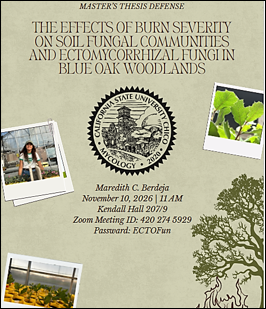
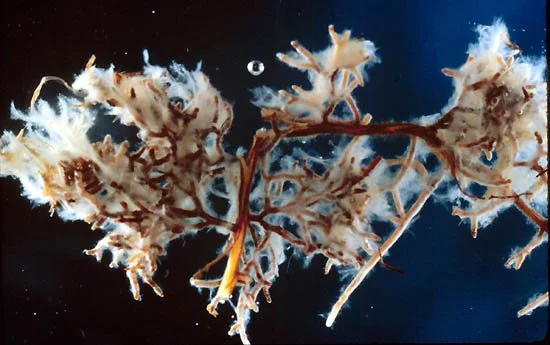
Ectomycorrhizal (ECM) fungi form partnerships with the roots of oaks and other trees, helping them take up water and nutrients in exchange for sugars. After a wildfire, regenerating seedlings depend on whatever fungal partners survive in the soil, yet we know little about how fire severity affects which ECM fungi persist. To address this, soils collected from an unburned area and from areas that burned at low, medium, and high severity were used to bait ECM fungi using blue oak (Quercus douglasii) seedlings in the greenhouse. ECM fungi colonizing seedling root tips were then identified using DNA sequencing. Seedlings grown in sterile soil had no ECM fungi, confirming that all colonization came from the field soils. Fire did not simply reduce ECM fungi but reshuffled which ones survived. Astraeus, the dominant fungus in unburned soil, was absent from all burned soils, while Hebeloma persisted across all severities and dominated roots grown in high-severity soil. Seedlings colonized by ECM fungi also grew more robustly than uncolonized seedlings. These results suggest that fire severity shapes the fungal partners available to the next generation of oaks, with implications for blue oak regeneration and post-fire restoration in California’s woodlands.
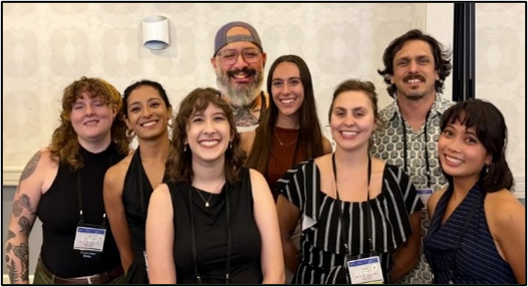
Gerald Cobián (Associate Professor of Biology and Co-director of the Ahart Herbarium at Chico State)
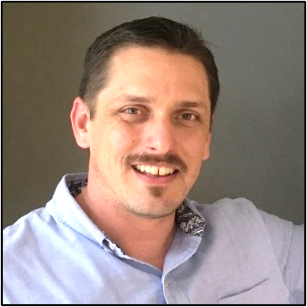
Born in Chico and raised largely in Southern California, Gerry Cobian graduated from Paradise High School and enlisted in the U.S. Marine Corps, serving as an infantry machine gunner. He then worked two years as a union iron worker before enrolling at Butte College with plans to study economics. Botany and biology courses with Dr. Mike Williams changed his direction and introduced him to blue oaks.
At UC Berkeley, Gerry earned a B.S. in Genetics and Plant Biology in 2012 while working in Dr. Tom Bruns's lab with then PhD student Dr. Nhu Nguyen, co-authoring a monograph on the mushroom genus Pluteus and testing whether the spores of truffle-like fungi survive passage through marmot guts. He completed his PhD in Botany at the University of Hawaiʻi at Mānoa in 2018 under Dr. Anthony Amend, studying the biogeography of plant-fungal interactions, then spent two years as a biologist with the U.S. Fish and Wildlife Service.
Since joining Chico State's Department of Biological Sciences in Fall 2020, Gerry has taught microbiology, microbial ecology, plant pathology, and plant physiology. His lab studies foliar fungal endophytes and their influence on leaf litter decomposition, as well as how fire affects ectomycorrhizal fungi. He plans to expand into characterizing the fungi of blue oak woodlands, returning to the trees that first drew him to biology.
As director, Gerry's first priority is getting to know the herbarium community. He also hopes to secure room for the collection to grow, expand student use, and build up its fungal holdings. He is a husband and father of two middle schoolers.
Maredith Berdeja (2025 Jokerst Award Winner & recent MS graduate from Chico State)
Maredith is a master’s student in Biological Sciences at California State University, Chico, and a Pre-Doctoral Scholar. Her research focuses on microbial ecology, specifically examining how the 2024 Park Fire affects soil fungal communities associated with blue oak (Quercus douglasii) at the Big Chico Creek Ecological Reserve. Her master’s research was awarded the 2025 Jim Jokerst Field Botany Award through the Ahart Herbarium. She earned her B.S. in Ecology, Evolution, and Organismal Biology with a minor in Sustainability at Chico State.